Professional Summary How to write a physician professional summary
Your professional summary is 3–4 lines at the top of the resume that answer one recruiter's question: "Why this candidate over the other 80 applicants?" Without it, even strong clinical experience reads as a list of dates and hospitals.
A strong summary names three things: your degree and credentials (MD, residency, ABMS board certification, state medical license), years and setting of clinical practice, and one outcome — a procedure count, a quality metric, or a recognised rotation. Avoid vague lines like "compassionate physician seeking growth opportunities".
WeakCompassionate and hardworking physician with clinical experience. Looking for a challenging role at a reputable hospital.
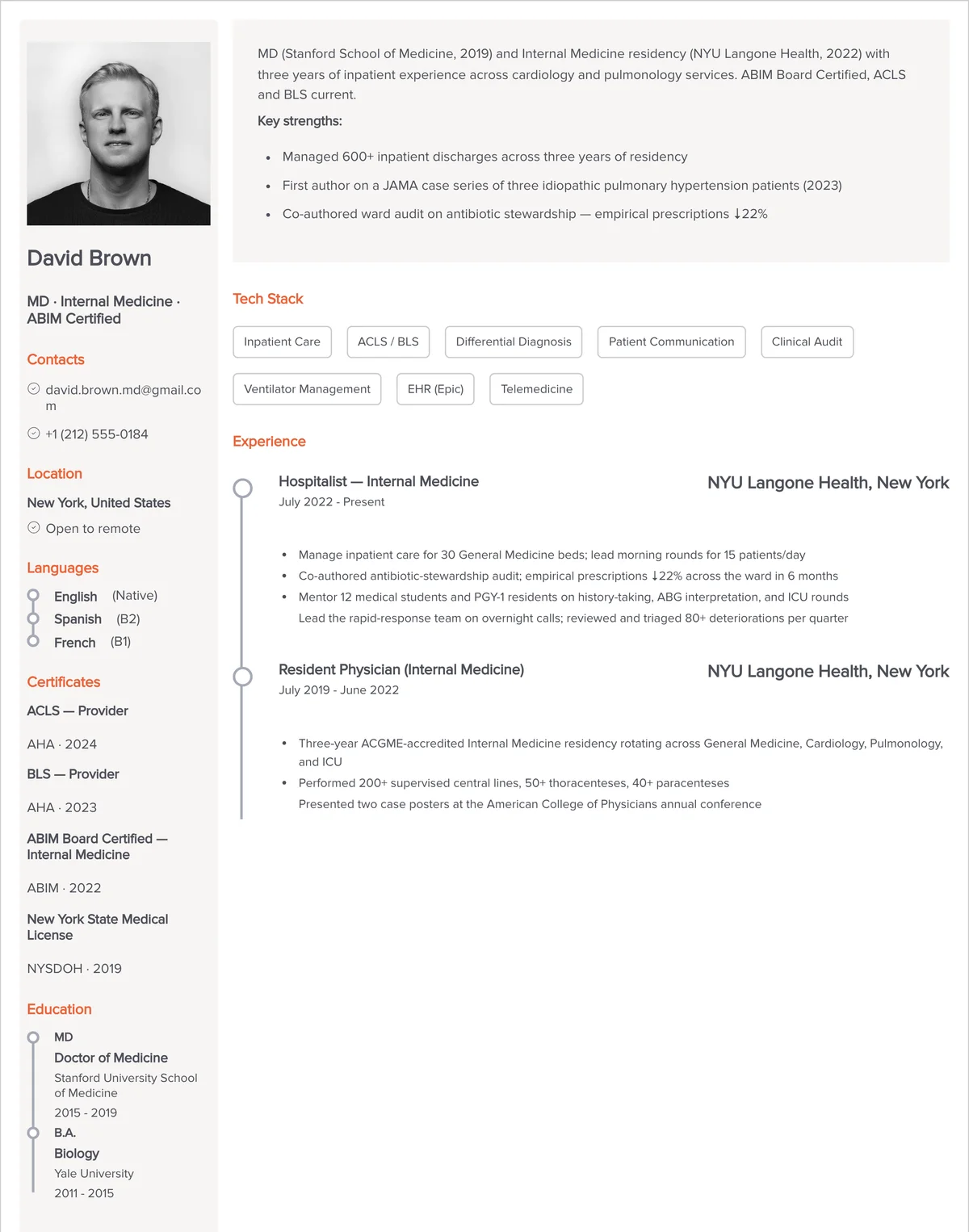
StrongMD (Stanford School of Medicine, 2019) with Internal Medicine residency at NYU Langone (2022) and three years of inpatient experience across cardiology and pulmonology services. ABIM Board Certified, ACLS-certified. Managed 600+ inpatient discharges; first author on a JAMA case series.
Recruiter tip
For residency-graduate roles, always lead with USMLE Step 1/2 scores if above the 75th percentile and ABMS board status. For senior roles, lead with patient volume, sub-specialty, and one quality metric.