Chef Resume 2026 - covers, food cost and brigade sample free

Антон Литвинов
Published: 29.04.2026 Updated: 03.10.2026

A chef resume is read by somebody who has stood on a line, and they are looking for four things in the first ten seconds: how many covers you can put out, what your food cost ran at, which stations you have actually owned, and whether your kitchen passes inspection. Everything else is decoration. The difficulty is that most chef resumes are written as a list of restaurants and a paragraph about passion for food, which tells the reader nothing they can schedule against. A chef de partie who ran saucier for 180 covers on a Saturday and a chef who held food cost at 29 percent across a 14-cook kitchen are two different hires, and both of those sentences are checkable. Write the volume, the money and the stations, name your ServSafe certification plainly, and the resume starts to read like somebody who has worked service rather than somebody who watched it.
Create resume → See the example 5 minutes - AI suggestions - ATS friendly
Ready sample

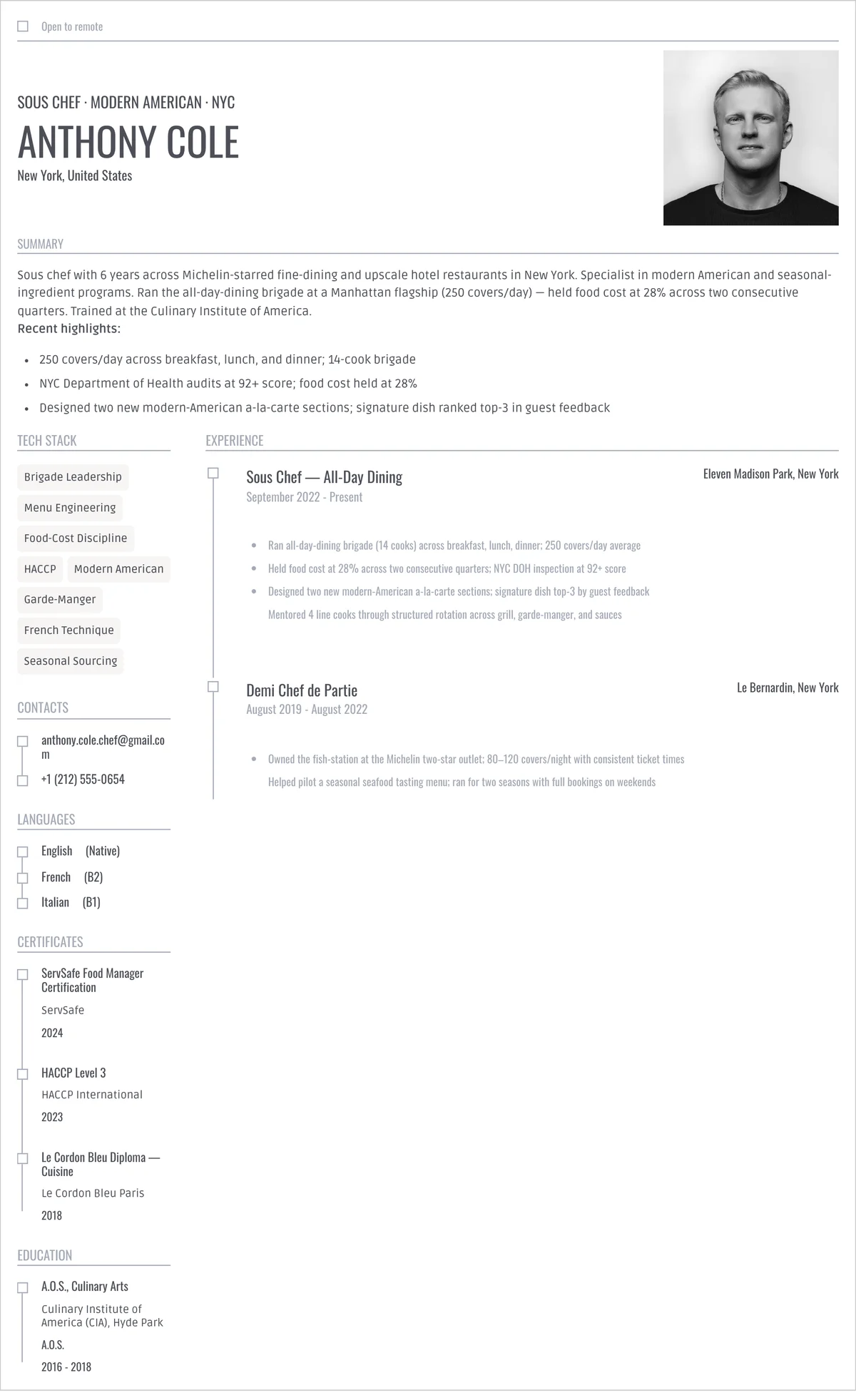
Chef resume sample

The order a chef-owner or a group executive chef reads in: level and stations first, volume second, cost control third, food safety fourth, and the people you have trained underneath all of it.

Stations and level, not just job titles

Sous chef at a 60-seat bistro and sous chef at a 400-cover hotel banquet operation are different jobs. Name the stations you have owned - saucier, grill, garde manger, patisserie - and the brigade size you ran.

Volume in covers

Covers per service, covers on a peak Saturday, ticket times at the pass, and the number of menus running at once. Kitchen staffing is arithmetic and covers are the unit it is done in.

Food cost and labour written as percentages

Food cost percentage held or reduced, waste as a percentage of purchases, labour percentage, and theoretical versus actual variance. This is the half of the job owners lose sleep over.

ATS friendly

Restaurant groups, hotels, healthcare and contract catering all recruit through applicant tracking systems. Single column, standard headings, plain terms like sous chef, HACCP, ServSafe, line cook, no photo, no tables and no menu-style graphic layouts.

Resume example — Chef Build a similar resume →

Sample resume text

Use it as a reference: keep the structure and wording, put in your own facts and numbers.

Marcus Deleon

Sous Chef
Portland, OR
marcus.deleon@example.com
(503) 555-0164
linkedin.com/in/example

Profile

Sous Chef with 7 years on scratch-cooking lines, Portland OR. Run a brigade of 11 across five stations for 190 to 240 dinner covers, holding a la carte ticket times at 14 minutes through peak. Hold food cost at 28.4 percent against a 30 percent target and cut protein waste from 4.1 to 2.3 percent of purchases. ServSafe Food Protection Manager certified, author of the current HACCP plan, three consecutive inspections with zero critical violations. Strongest on saucier and the pass; have run grill, garde manger and entremetier at volume.

Experience

Sous Chef2023 - present

Alder and Ash, Portland, OR - 110 seats, scratch New American, mid to upper price point

  • Lead a brigade of 11 across five stations for 190 to 240 dinner covers a night, holding a la carte ticket times at an average of 14 minutes through the 7 to 9 pm peak
  • Hold food cost at 28.4 percent against a 30 percent target by rebuilding par levels, running quarterly yield tests on all proteins and recosting the menu against invoices monthly
  • Cut protein waste from 4.1 to 2.3 percent of purchases in nine months through portion control checks, trim utilisation into stocks and staff meal, and a daily waste log reviewed at line check
  • Authored the kitchen's current HACCP plan and temperature logging routine; three consecutive health inspections with zero critical violations
  • Developed 23 menu items across four seasonal rotations, costing each to a target contribution margin before it went on the pass
  • Trained nine line cooks to run a station independently, two of whom were promoted to chef de partie, and cut kitchen turnover in half over two years
Chef de Partie - Saucier2021 - 2023

Carrick House Hotel, Seattle, WA - 240-seat restaurant plus banquet to 400 covers

  • Owned saucier for 150 to 200 a la carte covers and plated banquet services up to 400 covers, running batch production and controlled reheat to hold quality at volume
  • Standardised 40 sauce and stock recipes in grams with yield and plate cost, replacing an inherited set of handwritten cards
  • Covered grill and entremetier on rotation and ran the pass on the sous chef's days off
Line Cook2019 - 2021

Bramble Street Kitchen, Seattle, WA - 70 seats, bistro

  • Worked grill and garde manger for 90 to 130 covers, writing the daily prep list and taking deliveries on the morning shift
  • Broke down whole fish and primals to portion spec, recording yields for the head chef's costing sheet

Education

South Seattle College2017 - 2019

Associate of Applied Science, Culinary Arts

Skills

Saucier, grill, garde manger and entremetier stationsExpediting and calling service from the passButchery, fabrication and yield testingRecipe standardisation and plate costingFood cost, par levels, ordering and inventoryMenu development and seasonal rotationServSafe Food Protection Manager and HACCPAllergen matrix and cross-contact controlSous vide, combi oven and blast chill programmesScheduling, labour hours and line cook training

Certifications and Training

  • ServSafe Food Protection Manager - issued 2024, valid to 2029
  • ServSafe Allergens - 2024
  • HACCP for food service, 16 hours - 2023
  • Oregon Food Handler Card - current
  • American Culinary Federation Certified Sous Chef (CSC) - 2024

Download a resume template

Build your resume in our AI builder and export in the format you need

Use this template in the builder →

What you get

  • A complete chef resume sample
  • 3 PDF templates
  • A formula for writing covers, ticket times and food cost
  • 6 mistakes that cost kitchen interviews
Profile

Chef profile summary

Three or four lines: your current level, the cuisine and service style, covers per service, the brigade size you lead, and your food cost number. A chef reading applications is filling a specific hole in a specific kitchen, and the question underneath every line is whether you can run a service without them standing behind you.

If you are moving up rather than across - line cook to chef de partie, sous to head chef - use the summary to show you have already been doing the next job. Ordering, line checks, writing the prep list, running service on the head chef's days off and training new cooks are the duties that prove readiness, and they belong in the first paragraph rather than buried in a bullet on page two.

WeakPassionate chef with many years of experience in fast-paced kitchens. Creative, hardworking and dedicated to using fresh seasonal ingredients and delivering excellent food to every guest.
StrongSous Chef with 7 years on scratch-cooking lines, Portland OR. Run a brigade of 11 across five stations for 190 to 240 covers a night, ticket times averaging 14 minutes on a la carte and 9 on lunch. Hold food cost at 28.4 percent against a 30 percent target and cut waste from 4.1 to 2.3 percent of purchases through yield testing and par rebuilds. ServSafe Food Protection Manager certified, HACCP plan author, three consecutive health inspections with zero critical violations.
Tip
Put covers and food cost percentage in the first two lines. Every chef applicant writes that they are passionate; a cover count and a cost percentage are the only version of competence a hiring chef can verify in a phone call.
Skills

Chef skills for a resume

Cooking technique, kitchen economics, food safety and people management, in roughly that order of how often they are tested. Name the stations and the equipment, because a kitchen hiring for grill does not want to guess whether you have worked grill.

Hard skills

  • Brigade stations: saucier, entremetier, garde manger, poissonnier, rotisseur, patissier and tournant, with the station you are strongest on named first
  • Butchery and fabrication: primal breakdown, portioning to a stated weight, fish filleting, yield testing and recording yields in a costing sheet
  • Stocks, mother sauces, emulsions, reductions and pan work, plus bread, pastry and dessert plating if you have genuinely done them
  • Modern and volume methods: sous vide and circulator work, combi oven programmes, blast chilling and cook-chill, batch cooking and controlled reheating
  • Recipe standardisation in grams with yield, portion size and plate cost, and recipe costing against current invoice prices
  • Food cost control: theoretical versus actual variance, menu engineering by contribution margin, par levels, ordering, receiving, inventory counts and waste logs
  • Food safety: ServSafe Food Protection Manager certification, HACCP plan writing and monitoring, critical control points, temperature logging, cooling and reheating parameters, FIFO rotation, date labelling
  • Allergen control: allergen matrix maintenance, dedicated utensils and surfaces, cross-contact prevention, and communicating a substitution to the pass and the floor
  • Menu development: seasonal rotation, specials discipline, tasting menus, banquet and plated event menus, dietary and texture-modified variants
  • Kitchen systems: kitchen display systems and the ticket rail, point of sale item setup, inventory and ordering platforms, scheduling and labour-hour management
  • Equipment and maintenance: combi ovens, planchas, braising kettles, immersion blenders, vacuum sealers, deck ovens, slicers and the cleaning schedules each one needs
  • Opening work: kitchen build-out input, equipment specification, prep sheet design, station layout and training a brigade from zero

Soft skills

  • Calling a service from the pass so twelve people hear one voice
  • Holding standards on the last ticket of a 300-cover Saturday
  • Correcting a cook's plate without stopping the line or humiliating them
  • Reading the dining room and adjusting fire times before the floor asks
  • Taking a 86 or a delivery shortage and rewriting the special in ten minutes
  • Training a new line cook to run a station alone inside three weeks
  • Keeping the walk-in and the prep list in your head while plating
  • Saying no to a dish that will not hold at volume, with a reason
  • Giving the floor accurate allergen answers rather than a guess
  • Running a line check honestly, including on your own station
Experience

How to write chef experience

Formula: covers plus stations plus money plus people. 'Prepared and cooked menu items to a high standard' is the job description, not your experience. Covers per service and on a peak night, the stations you owned, the brigade you led, food cost percentage, waste reduction and the cooks you trained are the four numbers a hiring chef is actually scanning for.

Give each kitchen a line of context before the bullets: seats, service style, cuisine, price point and whether it was scratch cooking. A reader who does not know whether you came from a 40-seat tasting room or a 900-room hotel cannot judge any of your numbers, and chefs are rightly suspicious of volume claims with no venue attached.

Weak- Cooked food on various stations, assisted the head chef, kept the kitchen clean and helped with ordering and stock control.
Strong- Ran saucier and expo for 190 to 240 dinner covers in a 110-seat scratch kitchen, holding a la carte ticket times at 14 minutes through the 7 to 9 pm peak, and rebuilt the sauce and stock par levels to cut protein waste from 4.1 to 2.3 percent of purchases while food cost came down 1.6 points to 28.4 percent.
What to include
Seats and service style - covers per service and on a peak night - stations owned - brigade size led - ticket times - food cost and labour percentages - waste reduction - menu items developed - cooks trained and promoted - health inspection results.
Education

Education, certification and training

Cooking is still a trade you can enter without a diploma, and plenty of excellent chefs came up entirely on the line. What is not optional is food safety certification: a manager-level food protection certificate is required by most jurisdictions for the person in charge, and in a kitchen it is the one piece of paper a recruiter will check before anything else. Culinary school helps early and matters less once you have a decade of services behind you, so keep it to a line or two and let the kitchens carry the resume.

  • ServSafe Food Protection Manager certification with the year it was issued and its expiry, written exactly as that - it is a literal keyword filter
  • Your local or state food handler card, plus any county-level person-in-charge requirement your kitchen operated under
  • ServSafe Allergens, and allergen or coeliac-specific training if a venue required it
  • American Culinary Federation certification if you hold it: Certified Culinarian, Certified Sous Chef, Certified Chef de Cuisine, Certified Executive Chef or Certified Master Chef, with the designation spelled out
  • Culinary degree, diploma or apprenticeship in a single line with the institution and years, plus externship if it was substantial
  • HACCP training, and whether you authored or only monitored a plan
  • Alcohol service certification if you ran a venue where that fell to the kitchen management team
  • Specialist courses worth naming: butchery, charcuterie and cured meats, bread and viennoiserie, chocolate and sugar work, fermentation, nutrition or diet-modified cooking for healthcare settings
Careful
Do not list a certification that has lapsed without saying so. Food safety certificates have expiry dates, operators check them during onboarding, and an expired manager certificate can stop you being scheduled as person in charge on day one.
No experience

Chef resume with little kitchen experience

Nobody is hired as a chef from nothing, but the step from culinary school or a casual kitchen to a real chef de partie job is taken constantly, and the resume for it is built out of the two things a hiring chef needs to believe: that you can keep up, and that you will still be there in six months.

Translate whatever you have into service terms. A stage or an externship is real experience - say the kitchen's style, the covers it did and the stations you touched. Catering, a school cafeteria, a care home kitchen, a sandwich counter or a food truck all involve production volume, temperature control and prep discipline, and all of them can be written in covers and portions. Then show the certification, because a cook who already holds a food protection manager certificate is cheaper to onboard than one who does not.

  • Externship, stage or trial shifts: kitchen style, covers, stations worked and how long you stayed
  • Any production volume you have handled, written in covers or portions per shift rather than in adjectives
  • Food protection manager certification and food handler card, with dates
  • Prep and mise en place discipline: what you prepped daily, to what spec, and how it was stored and labelled
  • Availability stated plainly - nights, weekends and holidays, because that is the first thing a kitchen asks
  • Knife skills and technique demonstrated by task rather than claimed: breaking down whole fish, portioning primals, consistent brunoise at speed
  • Competitions, culinary salon entries or a documented personal project, if they show repeatable technique rather than one pretty plate

Ready to write your chef resume?

The builder puts your covers, stations and food cost numbers where a hiring chef will see them and keeps the layout parseable for restaurant group and hotel screening systems.

Mistakes

Common mistakes

No cover counts anywhere

Covers are the unit kitchens are measured in. A resume that lists six restaurants and never says how busy any of them were forces the reader to assume the quietest possible version of each one.

Cost control left out entirely

Above chef de partie, half the job is money: food cost percentage, waste, par levels, ordering and labour hours. A chef resume with no percentages reads like a cook's resume with a chef's title on it, and that is exactly the doubt an owner is testing for.

Stations never named

'Worked all sections' tells a hiring chef nothing about where to put you on Friday. Name the stations, say which one you are strongest on, and say which one you have run at volume rather than covered once.

Food safety certification missing or vague

A manager-level food protection certificate is a hard requirement for the person in charge in most jurisdictions. Writing 'food safety trained' instead of naming the certification and its year means an automated filter looking for that exact string never matches you.

A passion paragraph instead of a profile

Every applicant loves food. The profile is four lines of scarce space, and spending it on seasonal ingredients and creativity instead of covers, brigade size and cost control is the single most common waste on a chef resume.

A designed menu-style layout the system cannot read

Chefs like beautiful documents, and restaurant groups, hotels and contract caterers screen through applicant tracking systems that flatten them. Two columns interleave into nonsense, a skills table collapses, and a header image hides your contact details. The handsome version is for the interview, not the application.

Takeaways

Takeaways

Remember

  • Covers per service and on a peak night, first
  • Stations owned and brigade size led
  • Food cost and waste percentages
  • ServSafe and HACCP named exactly, with dates
  • Seats, service style and price point for every kitchen
  • Cooks trained and promoted, with numbers
Create resume →
FAQ

Frequently asked questions

Covers per service, with a peak figure alongside the average. It sets the scale of everything else you claim and it is the first thing a hiring chef converts into a mental staffing plan. Pair it with food cost percentage once you are at sous chef level or above, because together those two numbers describe both halves of the job - putting food out and keeping the kitchen solvent.
Use the brigade names a kitchen actually uses and attach volume to them. 'Owned saucier for 200 covers, covered grill and garde manger on rotation, and ran the pass two services a week' is specific enough to schedule from. Listing every station with no indication of depth reads as having touched all of them and mastered none, which is a worse impression than naming two and owning them.
Yes, from chef de partie upwards, and definitely as a sous or head chef. Food cost percentage, waste as a share of purchases and labour percentage are the numbers an owner reviews weekly, so a candidate who states them is speaking the language of the person signing the offer. Give the target you were held to alongside the number you achieved, because 28 percent against a 30 percent target is a clearer result than 28 percent on its own.
A manager-level food protection certification - ServSafe Food Protection Manager is the one most US operators recognise - plus whatever food handler card your state or county requires. Write the full name, the year of issue and the expiry. If you have authored a HACCP plan rather than just followed one, say so separately, because plan authorship is a management-level skill and it is rare enough on a resume to be worth the line.
No. Many chefs came up through the line without a culinary qualification, and a resume carrying a decade of credible services with real numbers will outweigh a diploma every time. School shortens the early climb and gives you vocabulary and technique faster, so if you have it, keep it to one line with the institution and years. If you do not have it, do not apologise for it or leave an awkward gap - put your training under the chefs you learned from and the kitchens you learned it in.
Show that you have already been doing the management half unofficially. Writing the prep list, running line checks, placing orders, taking deliveries, counting inventory, training new cooks and running service when the head chef was off are all sous chef duties, and a line cook who lists them with numbers attached is a far easier promotion to justify than one who only lists cooking. Add any cost work you have touched - yield tests, par rebuilds, waste logs - because that is the skill gap most line cooks have when they step up.
Restaurant groups, hotels, healthcare food service and contract catering nearly all take applications through an applicant tracking system, and the parser reads your document as plain text in reading order. It takes the line under your name as your job title, so write 'Sous Chef' there rather than 'Culinary Professional', and it reads your skills block as a flat list of keywords, so the strings 'ServSafe', 'HACCP', 'food cost' and the station names need to appear as text and not inside an image or a table. Keep one column, standard headings like Experience and Education, and dates in a consistent form such as 03/2022 - 06/2025, because a two-column design interleaves into unreadable fragments and a header graphic can swallow your phone number.
Yes - the full sample above, and all templates on this page. You can assemble your own resume from any of them in the builder for free and see the result; downloading the finished PDF is paid, by subscription or a one-time payment. The builder keeps the layout parseable, which matters because restaurant groups and hotels screen automatically before a chef reads anything.
Useful reading

Resume and interview advice

Tips

Driver Resume Guide: CDL, Delivery Driver and Dispatcher

How to show license class, endorsements, safety record and route numbers on a truck driver, delivery driver or dispatcher resume, with example bullets and the details carriers check first.

Read →
Tips

Customer Service Resume Skills for Tellers and Front Desk

The customer service skills that bank tellers, hotel front desk agents and receptionists should put on a resume, the systems and procedures to name, and bullet examples with numbers.

Read →
Tips

Hospitality Resume Guide: Hotel, Restaurant and Event Jobs

What hotel, restaurant and event employers look for, the numbers that make a hospitality resume stand out, ready-to-adapt bullets for each role and the certifications worth listing.

Read →
Related Professions

Resume examples for other roles

Create resume →